Deep autoencoder
A deep autoencoder is a type of artificial neural network designed for unsupervised learning and dimensionality reduction. It consists of an encoder and a decoder, both composed of multiple hidden layers. The encoder transforms input data into a compressed representation in a lower-dimensional space, while the decoder reconstructs the input from this representation. The deep architecture allows the autoencoder to capture hierarchical and abstract features in the data, making it effective for learning intricate patterns and representations. Training involves minimizing the difference between the input and the reconstructed output, encouraging the network to learn a compact and meaningful representation of the data. Deep autoencoders find applications in tasks such as data denoising, anomaly detection, and feature learning within the field of deep learning.
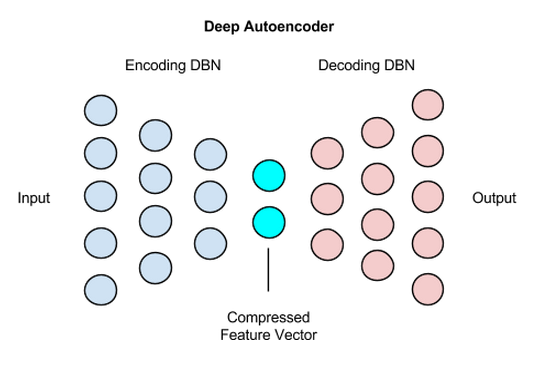
source: https://wiki.pathmind.com/deep-autoencoder. Source is good only for the image, not the content...